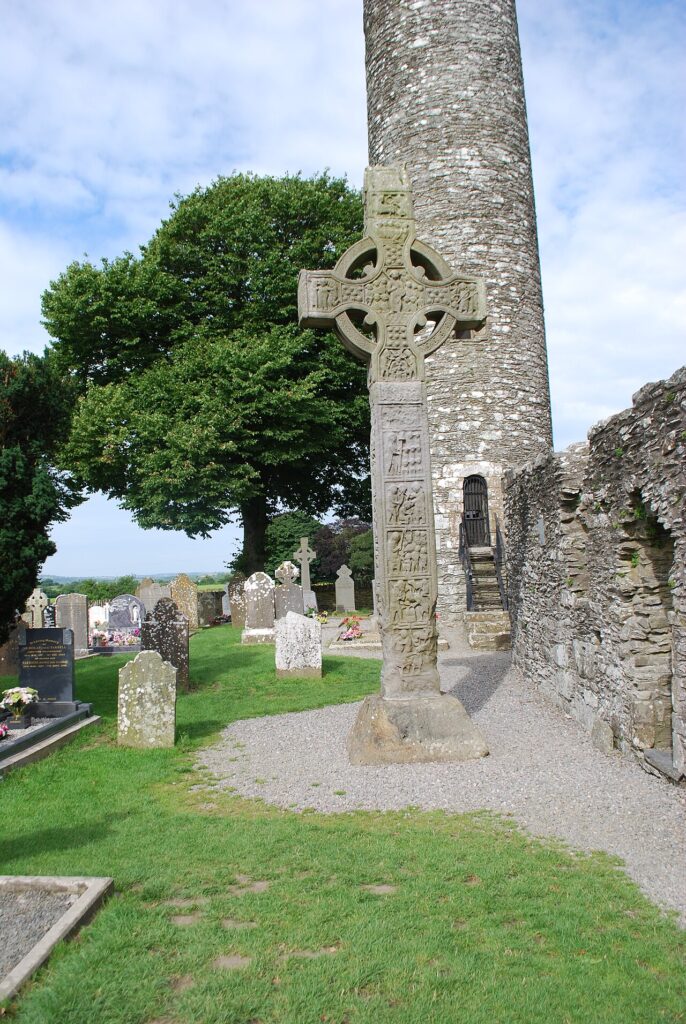
In a quiet corner of County Louth, surrounded by gravestones and the remains of two ancient churches, stands what many scholars consider the finest high cross in all of Ireland. Muiredach’s Cross at Monasterboice rises over 17 feet into the Boyne Valley sky, its sandstone surface covered in carvings so detailed and well-preserved that you can still make out individual figures carved more than a millennium ago.
This isn’t just another Celtic cross. It’s a masterwork of early medieval art, a stone Bible created when most people couldn’t read, and a testament to the skill of Irish craftsmen working around the year 922.
The Monastic City That Time Forgot
Monasterboice was founded by Saint Buithe in the late fifth century, making it one of Ireland’s oldest monastic settlements. At its peak, this was a thriving center of learning and spirituality, home to hundreds of monks who copied manuscripts, taught students, and created works of art that would outlast empires.
Today, the site is remarkably peaceful. There’s no visitor center, no ticket booth, just a simple gate that opens onto the ruins. You’ll find the remains of two churches, a round tower that lost its top centuries ago, and three high crosses. But it’s Muiredach’s Cross, named for an abbot who likely commissioned it, that draws people from around the world.
The cross stands in the older graveyard, weathered but astonishingly intact. Unlike many Irish high crosses that have lost detail to wind and rain, Muiredach’s Cross remains sharp enough that you can see the expressions on carved faces and count the fingers on sculpted hands.
Reading the Stone Bible
Every panel on this cross tells a story. The east face depicts scenes from the New Testament: the arrest of Christ, the crucifixion, and the risen Christ at the top. The west face shows Old Testament scenes including Cain slaying Abel, David and Goliath, and Moses striking the rock.
At the base of the cross, an inscription in Irish reads: “A prayer for Muiredach by whom this cross was made.” It’s one of the few high crosses that can be definitively dated and attributed, giving historians a crucial reference point for understanding other Irish crosses.
The ring around the cross head isn’t just decorative. It’s structural, preventing the arms from breaking under their own weight while creating the distinctive Celtic cross shape that Ireland is famous for. The bosses where the ring meets the arms are carved with intricate interlace patterns that show how Viking design influences were being absorbed into Irish Christian art.
The cap stone at the very top depicts a church or shrine, possibly representing the House of God or the heavenly Jerusalem. Even this small detail, barely visible from ground level, is executed with remarkable care.
Why This Cross Matters
Muiredach’s Cross represents the high point of Irish stone carving, created during what historians call the Golden Age of Irish Christianity. In the ninth and tenth centuries, even as Viking raids disrupted coastal monasteries, places like Monasterboice continued producing art that blended Irish, Christian, and Norse influences into something entirely unique.
The cross was designed as a teaching tool. In an age when books were rare and most people couldn’t read, these carved panels served as visual catechism, allowing monks to stand beside the cross and teach biblical stories to pilgrims and local communities. Each figure, each scene, was chosen to illustrate key moments in salvation history.
What makes this cross exceptional is its condition. Many Irish high crosses have been worn smooth by a thousand years of weather. Others were damaged during the Reformation or the Cromwellian period. Muiredach’s Cross survived largely intact, its sheltered position and durable sandstone preserving details that have vanished from other crosses.
Visiting Monasterboice Today
The site is located just off the M1 motorway between Dublin and Dundalk, about an hour’s drive north of the capital. There’s a small parking area, and access is free. The crosses stand in an active graveyard, so visitors are asked to be respectful.
Early morning is the best time to visit. The site opens at dawn, and if you arrive before the tour buses, you might have Muiredach’s Cross entirely to yourself. The morning light hits the east face first, illuminating the crucifixion scene and bringing out details in the carving that flatten in midday sun.
Don’t miss the West Cross, the second high cross at the site. While not as well-preserved as Muiredach’s, it’s even taller at nearly 21 feet and features different biblical scenes. The round tower, though truncated, still gives you a sense of how these monastic settlements would have looked in their prime.
There are no facilities at the site, but the nearby village of Monasterboice has a pub, and Drogheda is just 15 minutes away for meals and accommodation. Combine your visit with nearby Newgrange or the Hill of Slieve Gullion for a full day exploring Ireland’s ancient east.
Standing before Muiredach’s Cross, you’re looking at the same images, carved in the same stone, that monks studied over eleven centuries ago. The faces that peer out from biblical scenes, the interlaced patterns that dance across the ring, the careful inscription at the base—all of it has endured. It’s Ireland’s story in stone, and it’s still being read.
Want more stories from Ireland’s ancient places and hidden corners? Subscribe to the Ireland Moments newsletter for a daily celebration of the Emerald Isle delivered to your inbox.