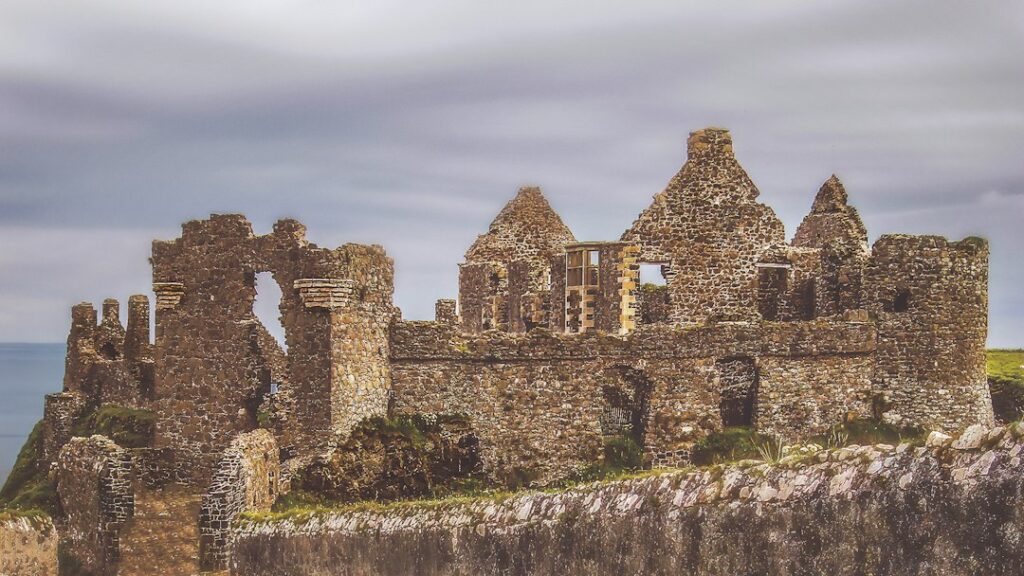
There are castles that stand on hills, and then there’s Dunluce Castle—a medieval fortress so audaciously positioned on a knife-edge cliff above the North Antrim coast that it seems to defy both gravity and good sense. Connected to the mainland by a narrow bridge spanning a chasm carved by Atlantic storms, Dunluce is less a building than a statement: this is what happens when ambition, warfare, and sheer stubbornness collide with one of Ireland’s wildest coastlines.
Just a few miles west of the Giant’s Causeway, Dunluce Castle has been clinging to its basalt outcrop since the 13th century, though the dramatic ruins you see today date mostly from the 16th and 17th centuries. It’s a place where Irish chieftains, Scottish mercenaries, and English armies all left their mark—and where the sea ultimately had the last word.
A Castle Built for Battle and Beauty
Dunluce was originally built by the MacQuillan family, but it’s the MacDonnells—later the Earls of Antrim—who made it legendary. In 1584, Sorley Boy MacDonnell seized the castle and transformed it into a stronghold befitting a Gaelic lord with Scottish roots and European ambitions. He added Renaissance touches, imported cannons salvaged from the wrecked Spanish Armada ship Girona, and turned Dunluce into one of the most formidable fortresses on the Irish coast.
The castle’s position was both its greatest strength and its fatal flaw. Attackers had to cross a narrow bridge with sheer drops on either side, making it nearly impregnable. But the Atlantic, indifferent to military strategy, was slowly eating away at the cliff beneath.
The Night the Kitchen Fell Into the Sea
The most famous chapter in Dunluce’s history came on a stormy night in 1639, when part of the castle’s kitchen collapsed into the sea, taking several servants with it. Some say it was a catastrophic storm; others whisper it was the final warning from a coastline that had been undermined for centuries. Whatever the cause, the Countess of Antrim decided she’d had enough. The family abandoned Dunluce shortly after, leaving it to the gulls, the wind, and the relentless waves.
Today, you can still see where the kitchen once stood—a gaping absence at the cliff’s edge, a reminder that no matter how grand your fortress, the sea always wins.
Visiting Dunluce Castle
Dunluce is managed by the Northern Ireland Environment Agency and is open year-round, though hours vary by season. Admission is around $7 for adults. The site includes interpretive panels, the restored gatehouse, and access to the castle ruins themselves, including the Great Hall, the tower house, and the hauntingly empty space where the kitchen used to be.
Wear sturdy shoes—the ground is uneven, the winds can be fierce, and the views over the Atlantic are dizzying. On a clear day, you can see Scotland’s coastline across the water, a reminder of the MacDonnells’ roots and the web of alliances that once stretched across the Irish Sea.
The nearby town of Bushmills, home to the world’s oldest licensed whiskey distillery, makes an excellent base. After walking the windswept ruins, a dram of Bushmills and a bowl of chowder at a local pub feels like the perfect antidote to the salt and the stories.
Why Dunluce Still Captivates
Dunluce Castle isn’t just a ruin—it’s a stage set for the entire drama of Irish history. It’s been a Gaelic stronghold, a Renaissance showpiece, a smugglers’ den, and an inspiration for writers and filmmakers. (If the silhouette looks familiar, it’s been said to inspire the castle in C.S. Lewis’s Chronicles of Narnia, and it’s appeared in Game of Thrones as House Greyjoy’s seat, Pyke.)
But what makes Dunluce unforgettable is the way it feels both triumphant and doomed. Standing on that narrow bridge, looking up at the crumbling towers and out at the endless ocean, you’re caught between human daring and nature’s indifference. It’s a place that reminds you why castles were built—and why, eventually, they all fall.
If you love Ireland’s castles, coastlines, and the stories that bind them together, subscribe to the Ireland Moments newsletter—a daily celebration of the island’s history, beauty, and spirit, delivered straight to your inbox.