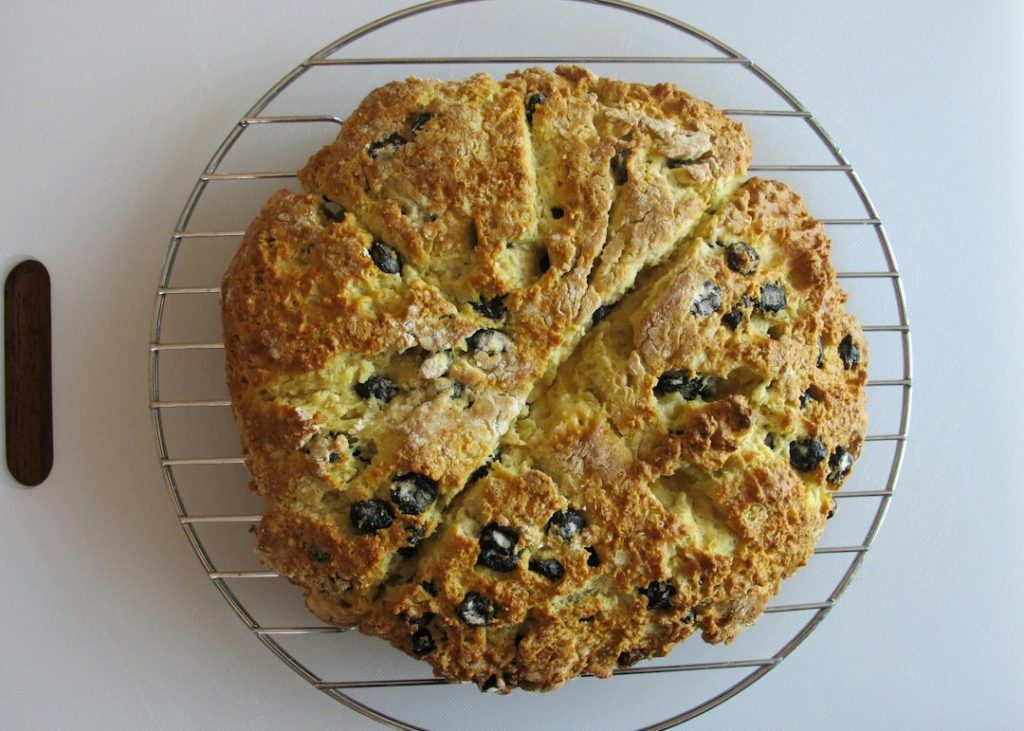
Walk into any Irish kitchen, and you’ll likely find a loaf of soda bread cooling on the counter. No mixer. No proving time. No fuss. Just four ingredients mixed in a bowl, shaped with floured hands, and baked until the crust turns golden and the house smells like home.
Irish soda bread is the ultimate everyday loaf, born from necessity and perfected through generations. It’s the bread that fed families through hard times, that appears at every Irish breakfast table, and that tastes better with butter than anything you’ll buy in a bakery.
How Soda Bread Came to Ireland
Before the 1840s, most Irish bread was made with yeast or baked on griddles over open fires. But when baking soda became widely available in the mid-19th century, Irish home bakers found the perfect solution to a practical problem: yeast was expensive, temperamental, and required time most working families didn’t have.
Baking soda, when combined with the acidity of buttermilk, creates carbon dioxide that makes dough rise quickly without fermentation. The result was a bread that could go from cupboard to table in under an hour. Soft wheat flour, common in Ireland, worked beautifully with this method, producing a tender crumb that’s slightly denser than yeasted bread but never heavy.
The iconic cross cut into the top wasn’t just decorative. It helped the heat penetrate the thick dough and, according to folklore, let the fairies out or warded off the devil. Practical magic at its best.
The Real Recipe: Keep It Simple
Authentic Irish soda bread contains just four ingredients: wholemeal or white flour, buttermilk, salt, and bread soda (baking soda). That’s it. No eggs, no butter, no sugar, no raisins. Those sweet, cake-like versions sold as “Irish soda bread” in American bakeries are a different animal entirely—closer to a scone than the real thing.
The traditional loaf is savory, with a slightly tangy flavor from the buttermilk and a hearty, rustic texture. It’s meant to be sliced thick, spread with salted Irish butter, and eaten alongside soup, stew, smoked salmon, or a fry-up. Some bakers use all wholemeal flour for a nuttier, denser loaf, while others mix white and wholemeal for something lighter.
In parts of Ireland, you’ll find regional variations: treacle brown bread sweetened with molasses, spotted dog with raisins and caraway seeds, or griddle-baked farls cut into quarters. But the backbone remains the same—simplicity, speed, and flavor.
Why It Still Matters Today
In a world of sourdough starters and 48-hour ferments, soda bread is a gentle rebellion. It reminds us that good bread doesn’t require fancy equipment or expert technique. You don’t need to be a baker to make it. You just need to be hungry.
Irish households still bake soda bread several times a week. It’s the loaf you make when friends drop by unexpectedly, when the bread bin is empty, or when you want something warm to go with dinner. It’s forgiving, adaptable, and always welcome.
Visitors to Ireland often remember soda bread as one of their favorite discoveries—served at B&Bs, tucked into picnic baskets, or handed across the counter at a country market still warm from the oven. It’s humble, honest, and unmistakably Irish.
How to Eat It the Irish Way
Soda bread is best eaten on the day it’s baked, though it keeps well for a couple of days wrapped in a tea towel. Toast yesterday’s slices and they’ll come back to life.
The classic pairing is with salted butter—lots of it. Beyond that, it’s perfect with marmalade at breakfast, alongside a bowl of seafood chowder, or with farmhouse cheddar and chutney. In County Cork, you’ll find it served with crubeens (pig’s feet). In Donegal, it’s spread with dulse butter made from dried seaweed.
Some people dunk it in tea. Others use it to mop up the last of their Irish stew. There’s no wrong way, as long as you’re generous with the butter.
If you want to bake your own, dozens of recipes are just a search away—but the best ones are the simplest. Mix, shape, score, bake. In less than an hour, you’ll understand why this bread has lasted nearly two centuries.
Love stories like this? Subscribe to the Ireland Moments newsletter for a daily celebration of Ireland—delivered straight to your inbox.