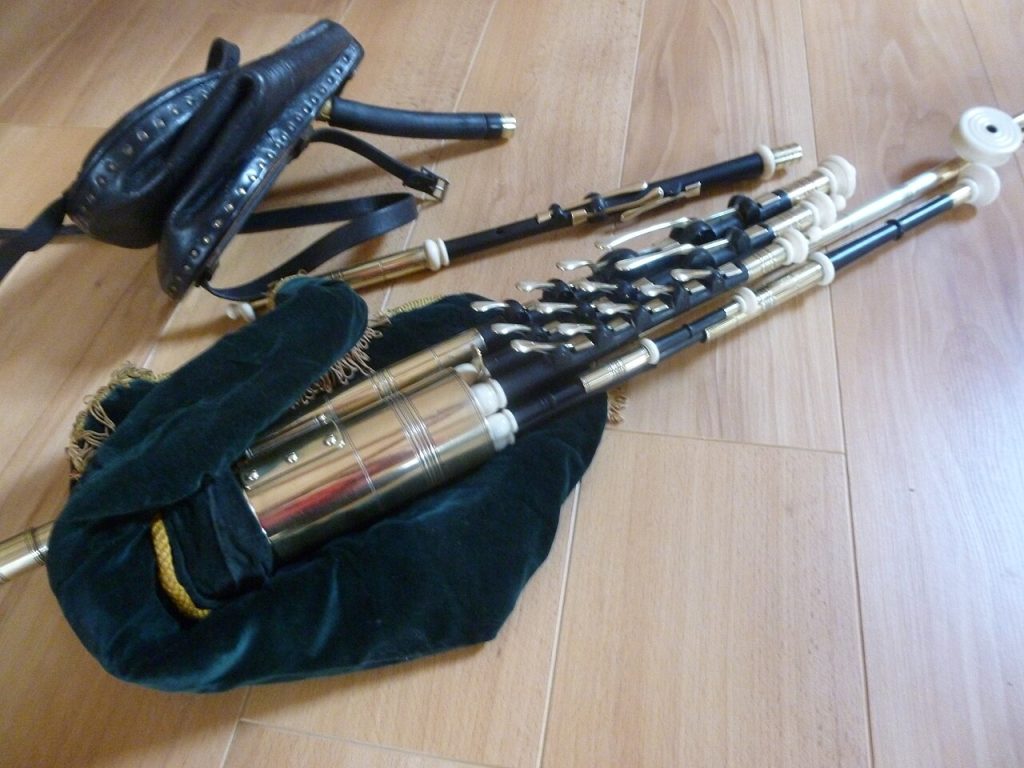
If the fiddle is Ireland‘s voice and the bodhrán its heartbeat, then the uilleann pipes are its soul laid bare. Pronounced “ill-in,” these pipes represent the pinnacle of Irish instrument craftsmanship—a bellows-blown wonder capable of producing three octaves, harmony, and a range of expression no other bagpipe in the world can match.
Unlike their Scottish cousins, uilleann pipes aren’t blown by mouth. They’re powered by a bellows strapped under the piper’s elbow, allowing for a softer, sweeter tone and the ability to sing while playing. But that’s just the beginning of what makes them extraordinary.
A Mechanical Marvel With Moving Parts
The uilleann pipes consist of several components working in concert: the bag, bellows, chanter, drones, and regulators. The chanter produces the melody, while three drones provide a continuous harmonic backdrop in bass, baritone, and tenor. But it’s the regulators—a set of closed pipes with keys—that set uilleann pipes apart from every other bagpipe tradition on earth.
Regulators allow the piper to play chords and rhythmic accompaniment by pressing keys with the wrist or palm while the melody unfolds on the chanter. It’s like having a small keyboard built into your instrument. Mastering this coordination takes years, sometimes decades. Many pipers spend a lifetime perfecting the art.
The chanter itself can be played in two modes: open, with a continuous sound, or closed against the knee to produce staccato notes and rests. This gives uilleann pipers a level of articulation and dynamic control unmatched in the bagpipe world.
From Street Music to Concert Halls
Uilleann pipes emerged in Ireland during the 18th century, evolving from earlier pastoral pipes. By the 1800s, they were the instrument of choice for itinerant pipers who traveled from town to town, playing at fairs, weddings, and wakes. The pipes were intimate, expressive, and suited to indoor settings—perfect for a pub session or a fireside gathering.
The tradition nearly disappeared in the early 20th century as emigration, poverty, and cultural suppression took their toll. By the 1960s, only a handful of master pipers remained. But the folk revival brought renewed interest, and organizations like Na Píobairí Uilleann, founded in Dublin in 1968, dedicated themselves to preserving and teaching the craft.
Today, uilleann pipers perform everywhere from intimate sessions in Ennis and Miltown Malbay to stages at Carnegie Hall and the Sydney Opera House. Players like Liam O’Flynn, Paddy Keenan, and Davy Spillane brought the pipes into modern consciousness, while a new generation continues to push the tradition forward.
Where to Hear Them Live
If you want to experience uilleann pipes in their natural habitat, County Clare is your best bet. The pubs of Doolin, Ennis, and Feakle regularly host pipers during trad sessions, especially during festival season. The Willie Clancy Summer School, held every July in Miltown Malbay, is the world’s premier gathering for uilleann piping, with workshops, concerts, and sessions running day and night.
In Dublin, you’ll find pipers at sessions in The Cobblestone and Hughes’ Bar, both hubs for serious traditional musicians. Galway’s Crane Bar and Tigh Coilí also feature regular performances. But the magic often happens unexpectedly—a piper settling into a corner, unstrapping the bellows, and filling the room with a slow air that silences every conversation.
Hearing the pipes live is transformative. The sound is warm and reedy, with a melancholy sweetness that can make a jig feel joyful and a lament feel like a prayer. When a skilled piper closes out a tune with a cascade of regulator chords, it’s pure alchemy.
Why They Matter
The uilleann pipes are more than an instrument—they’re a living archive of Irish musical identity. Each pipe set is handmade, often taking years to craft, with makers like Andreas Rogge, Benedict Koehler, and Cillian Ó Bríain continuing a tradition of artisan pipe-making that spans generations. A full concert-pitch set can cost upwards of $15,000 to $25,000, a reflection of the labor, skill, and materials involved.
Learning to play them requires patience, dedication, and a willingness to fail often. But those who commit discover an instrument capable of extraordinary beauty—one that breathes, bends, and responds to the subtlest touch. The uilleann pipes don’t just play Irish music; they embody it.
Whether you’re a musician, a music lover, or simply someone drawn to the deeper currents of Irish culture, the uilleann pipes deserve your attention. They are Ireland’s most complex, most expressive, and most hauntingly beautiful voice.
Want more stories celebrating Ireland’s music, culture, and traditions? Subscribe to the Ireland Moments newsletter—a daily celebration of the Emerald Isle delivered straight to your inbox.