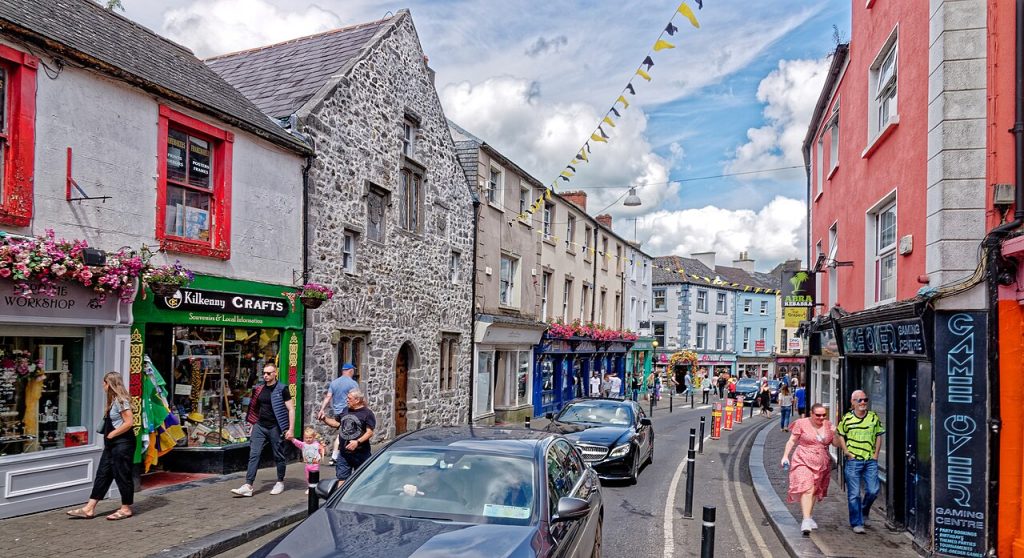
Kilkenny may be small, but its Medieval Mile packs more history, architecture, and atmosphere into a single walkable stretch than cities ten times its size. This compact route connects two of Ireland‘s finest medieval landmarks — Kilkenny Castle and St. Canice’s Cathedral — through a perfectly preserved streetscape of limestone buildings, hidden courtyards, and narrow lanes that look much as they did 800 years ago.
Walk it once and you’ll understand why Kilkenny was Ireland’s medieval capital, and why it remains one of the country’s most loved towns.
The Castle That Anchors Everything
Your walk begins at Kilkenny Castle, the Norman stronghold built in 1195 by William Marshal. The castle overlooks the River Nore and has been restored to reflect its Victorian grandeur, complete with the Long Gallery’s painted ceiling and pre-Raphaelite portraits. Entry is around $10, and the rose garden and parklands are free to wander.
But the real magic starts when you leave the castle gates and head up Parliament Street into the heart of the medieval city. The streets here follow the same layout as they did in the 13th century, when Kilkenny was the seat of Irish parliaments and the unofficial capital of the country.
What You’ll Find Along the Mile
The Medieval Mile isn’t a rigid route — it’s a web of interconnected streets and alleys, each with its own story. Rothe House, a rare surviving Tudor merchant’s house built in 1594, now holds a museum showcasing Kilkenny’s crafts and trades. The Shee Alms House, dating to 1582, is now the tourist office and a beautiful example of almshouse architecture.
St. Mary’s Cathedral, built in the 1840s on the site of a medieval church, towers over the town with Gothic Revival confidence. The Black Abbey, founded by Dominicans in 1225, still holds services and features a stunning medieval Rosary Window. Kyteler’s Inn, one of Ireland’s oldest buildings, was home to Dame Alice Kyteler, accused of witchcraft in 1324 — and the pub still serves pints in rooms where she once lived.
Everywhere you turn, there are carved doorways, limestone facades, and narrow slipways that open onto the river. The Butter Slip, a steep medieval lane once used by butter sellers, is barely wide enough for two people to pass.
St. Canice’s Cathedral and the Round Tower
The Medieval Mile ends at St. Canice’s Cathedral, one of Ireland’s finest medieval churches. Built in the 13th century on the site of a 6th-century monastery founded by St. Canice himself, the cathedral is a masterpiece of Early English Gothic style. Inside, you’ll find black Kilkenny marble floors, intricate stone carvings, and over 500 years of tomb monuments.
Next to the cathedral stands a perfectly intact 9th-century round tower, one of only two in Ireland you can still climb. The 100-foot ascent up narrow stone steps and wooden ladders rewards you with sweeping views over Kilkenny’s rooftops, the Nore Valley, and the Slieve Bloom Mountains beyond. Entry to the cathedral and tower is around $8.
Why It’s Ireland’s Best Medieval Walk
Unlike larger cities where medieval quarters are fragments surrounded by sprawl, Kilkenny’s Medieval Mile is cohesive, compact, and still alive. You can walk the entire route in 30 minutes, but you’ll want to take two or three hours to explore the side streets, pop into craft shops, and sit in a pub where Vikings once traded.
Kilkenny also has one of the best concentrations of craft studios and galleries in Ireland, many housed in medieval buildings. The Kilkenny Design Centre, located in the former stables of the castle, showcases the best of Irish craft and design.
The town hosts the Kilkenny Arts Festival every August, transforming the medieval streets into stages, galleries, and performance spaces. Even on quiet weekdays, there’s an energy here — a sense that this isn’t a museum town, but a living medieval city that never stopped being one.
Start at the castle. End at the cathedral. Let yourself get lost in between. That’s the Medieval Mile, and there’s nothing else quite like it in Ireland.
Love stories like this? Subscribe to the Ireland Moments newsletter and get a daily celebration of Ireland — its places, culture, music, and history — delivered to your inbox.