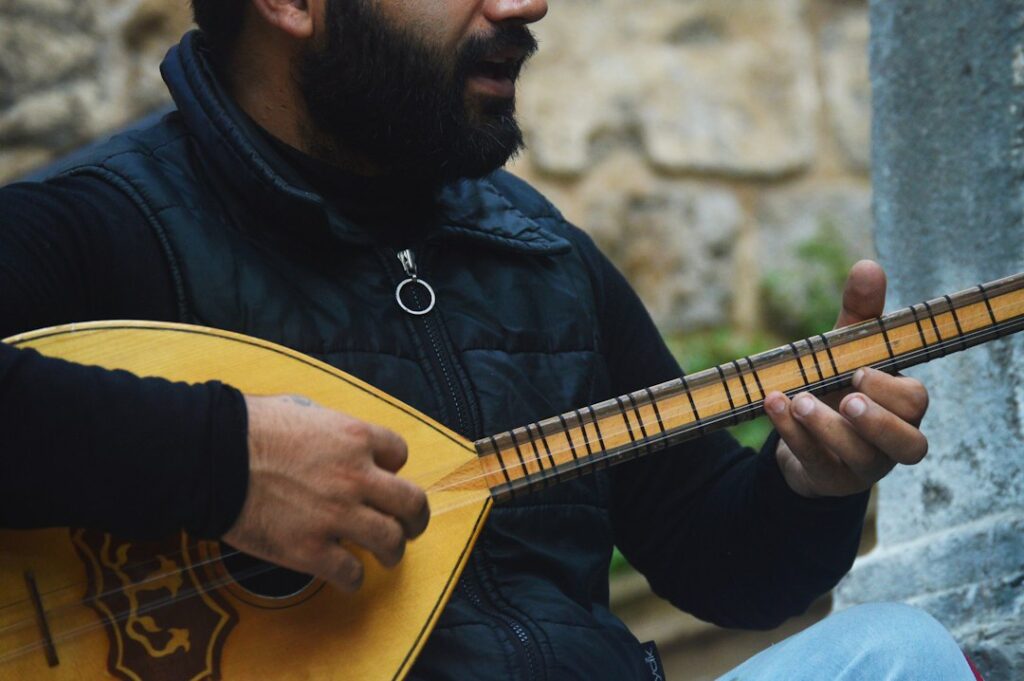
Walk into any serious trad session in Ireland today and you’ll likely hear it—the bright, ringing chord progressions that anchor the melody, the rhythmic pulse that drives the reels forward, the harmonic depth that makes a tune feel fuller. That’s the Irish bouzouki at work, and it’s hard to imagine the contemporary session without it.
What makes this remarkable is that the bouzouki isn’t Irish at all. It’s Greek. And it only arrived in Ireland about sixty years ago.
The Unexpected Arrival
The story begins in the mid-1960s, when Irish musician Johnny Moynihan picked up a Greek bouzouki in a London music shop. The instrument—traditionally used in rebetiko music—had a rounded back, eight metal strings in four pairs, and a bright, mandolin-like sound. Moynihan brought it back to Dublin and began experimenting with it in folk and traditional settings.
Around the same time, Andy Irvine and Dónal Lunny also took up the instrument. They quickly realized that while the Greek bouzouki worked, it needed adaptation for Irish music. Luthiers began building flat-backed versions with longer necks and different tunings. These Irish bouzoukis became louder, punchier, and better suited to the demands of session playing.
By the 1970s, the bouzouki had become a fixture in bands like Planxty and The Bothy Band, where Lunny used it to brilliant effect—adding harmonic complexity and rhythmic drive that traditional Irish music had rarely explored before.
What It Brings to the Session
The bouzouki fills a unique role. It’s not a melody instrument like the fiddle or flute, and it’s not purely rhythmic like the bodhrán. It sits somewhere in between—providing chordal accompaniment, bass lines, and rhythmic accents all at once.
In a session, a good bouzouki player knows when to lay back and when to push. During a slow air, the bouzouki can add gentle harmonic color without overwhelming the singer. During a fast reel or jig, it drives the rhythm forward, its metallic ring cutting through the sound of fiddles and flutes.
The instrument also opened up new possibilities for arrangement and composition. Suddenly, traditional tunes could be harmonized in ways that felt fresh but not foreign. Musicians began writing new tunes with the bouzouki in mind, creating a whole generation of Irish music that simply wouldn’t exist without it.
Where to Hear It
If you want to hear the bouzouki in its element, head to any of Ireland’s great music towns. In Galway, check out Tigh Neachtain or Taaffes, where sessions often feature skilled bouzouki players. In Clare, the pubs of Ennis and Doolin regularly showcase the instrument alongside fiddles and concertinas.
Listening to recordings is equally rewarding. Planxty’s self-titled 1973 album is a masterclass in what the bouzouki can do. Dónal Lunny’s work with The Bothy Band and later with Moving Hearts pushed the instrument even further, blending traditional music with jazz and rock influences.
Today, builders like Paddy Burkett and Stefan Sobell craft some of the finest Irish bouzoukis in the world, each one a unique voice. Players like Alec Finn, John McSherry, and Zoë Conway have continued to expand the instrument’s vocabulary, proving that the bouzouki’s story in Ireland is still being written.
An Outsider That Became Essential
The bouzouki’s journey is a reminder that Irish traditional music has always been a living tradition—one that absorbs, adapts, and evolves. An instrument from Greece became Irish not by birthright but by being played with feeling, respect, and imagination.
It didn’t replace anything. It added something. And in doing so, it helped shape the sound of Irish music for generations to come.
Love stories like this? Subscribe to the Ireland Moments newsletter—a daily celebration of Ireland’s music, places, culture, and the moments that make the Emerald Isle unforgettable.