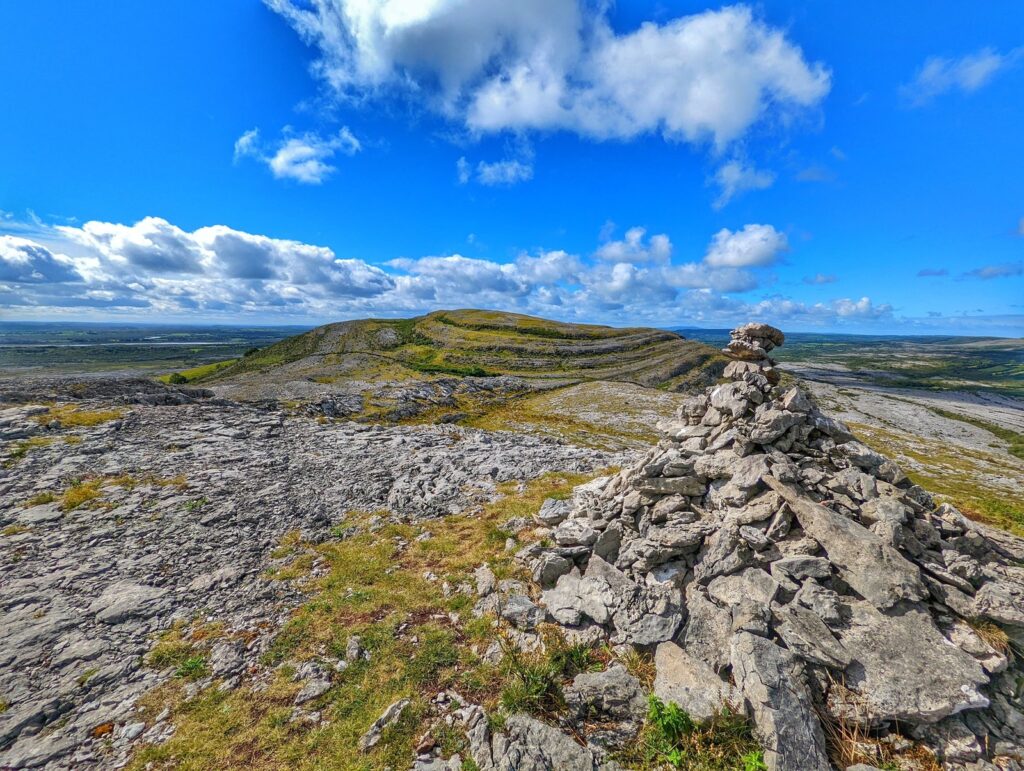
The first time you stand on the Burren‘s limestone pavement, the world goes quiet. Beneath your feet, gray stone stretches to the horizon in flat slabs cracked into geometric patterns. No trees. Few hedges. Just endless rock carved by rain and time into one of Ireland’s strangest and most beautiful places.
This is the Burren—from the Irish Boíreann, meaning “great rock”—a 250-square-kilometer karst landscape in north County Clare that looks more like the surface of the moon than the green fields you expect from Ireland. Yet closer inspection reveals a hidden world: rare wildflowers blooming in the cracks, underground rivers carving caves through the bedrock, and ancient monuments rising from the stone.
A Landscape 350 Million Years in the Making
The Burren’s limestone formed on a tropical seabed during the Carboniferous period, when Ireland sat near the equator. Over millennia, layers of shells and coral compacted into rock. Then came the Ice Age, which scraped away the soil and left the bare stone exposed. Rainwater did the rest, dissolving the limestone along its joints and creating the distinctive pavement of flat slabs separated by deep fissures called grikes.
What remains is a place that feels both ancient and alien. English general Edmund Ludlow, who marched through the Burren in the 1650s, famously complained it had “not enough water to drown a man, wood enough to hang one, nor earth enough to bury him.” He missed the point entirely.
The Botanical Miracle Growing in the Cracks
The Burren’s true magic happens in those grikes—the deep cracks between the limestone slabs. Sheltered from wind and grazing animals, warmed by heat radiating from the stone, these miniature ecosystems support one of the rarest plant assemblages in Europe. Arctic-Alpine species like mountain avens grow alongside Mediterranean flowers like the dense-flowered orchid. Spring gentians carpet the stone in electric blue each May.
Nowhere else in the world do these plants from three different climate zones grow together naturally. Botanists have recorded more than 700 species here, including 23 of Ireland’s 27 native orchids. The Burren is proof that even the harshest landscapes can sustain extraordinary life—you just need to look closely.
Where to Walk and What to See
Start at the Burren National Park near Corofin, where marked trails wind through hazel scrubland and across open pavement. The park protects roughly 15 square kilometers of the most botanically rich terrain, and entry is free. Spring and early summer offer the best wildflower displays, though the landscape holds its stark beauty year-round.
For a more dramatic vista, drive the narrow road to the top of Mullaghmore, the Burren’s highest hill. From the summit cairn, you can see the full sweep of the limestone terraces stepping down to Galway Bay, with the Aran Islands visible on clear days. The Poulnabrone Dolmen—a 5,000-year-old portal tomb balanced on slender stones—rises from the pavement a few kilometers south and remains one of Ireland’s most photographed ancient sites.
Don’t miss the Burren Perfumery near Carron, where distillers create scents from local wildflowers and herbs, or the Aillwee Cave, where you can walk through chambers carved by an underground river and see the remains of bears that hibernated here thousands of years ago.
Respecting a Fragile Ecosystem
The Burren looks indestructible, but its ecosystem is delicate. Walk only on established paths or bare rock—never through wildflower areas. The plants growing in the grikes took decades to establish and can be destroyed in seconds by a careless boot. Don’t remove stones or plants, and if you’re visiting in spring or summer, resist the urge to pick the flowers. They’re protected for good reason.
Traditional farming practices—particularly winter grazing by cattle—actually help maintain the Burren’s biodiversity by preventing scrub from overtaking the open pavement. When you see cattle wandering the stone, they’re part of the landscape’s long history, not intruders.
The Burren teaches you to see beauty in barrenness, complexity in what first appears simple. It’s a place that rewards patience and attention—every crack in the stone, every wildflower clinging to existence, every wedge tomb placed by people who understood this land long before us. In a country famous for green hills and soft rain, the Burren stands apart: hard, bright, and utterly unforgettable.
Want more stories celebrating Ireland’s remarkable landscapes, culture, and traditions? Subscribe to the Ireland Moments newsletter—a daily celebration of the Emerald Isle delivered to your inbox.