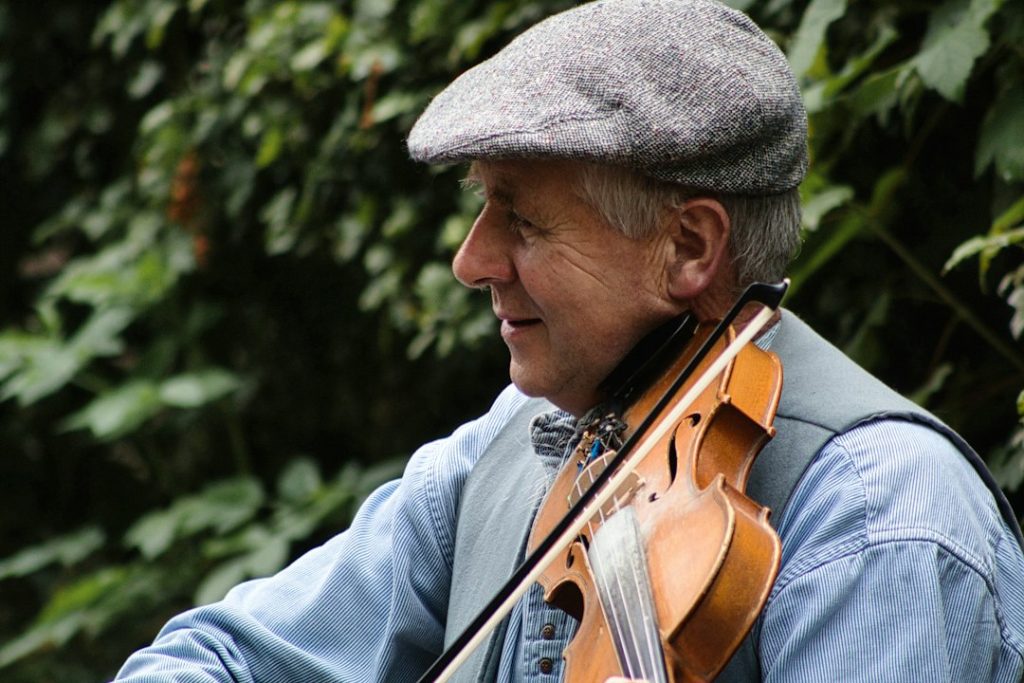
Walk into any trad session from Doolin to Dingle, and within minutes you’ll hear it: the clear, singing voice of the fiddle cutting through the room. It’s the sound that leads the dance, carries the slow air, and binds a tune together when five musicians are playing five different ornamentations of the same reel.
The fiddle isn’t just popular in Irish music. It’s essential. And understanding why tells you something deeper about Ireland itself.
The Instrument That Came and Stayed
The fiddle arrived in Ireland sometime in the 17th century, brought by traveling musicians and the Anglo-Norman gentry. But while other imported instruments remained novelties or status symbols, the fiddle found its way into ordinary homes.
Part of the reason was practical. A fiddle was portable, relatively affordable, and loud enough to fill a kitchen or a country hall. It could play fast dance tunes and slow, mournful airs with equal expression. And critically, it could mimic the human voice—something central to Irish music, where ornamentation and phrasing often echo sean-nós singing.
By the 18th century, traveling fiddle masters were moving across the countryside, teaching local players and leaving behind regional styles that still exist today. In Donegal, fiddlers developed a wild, driving rhythm. In Sligo, the style became smoother and more lyrical. In Sliabh Luachra, on the Cork-Kerry border, slides and polkas took hold, and the fiddle became the backbone of a whole dance tradition.
Regional Styles That Define Irish Fiddling
Irish fiddle music isn’t a single sound—it’s a collection of dialects. The Donegal style, shaped by fiddlers like Con Cassidy and John Doherty, favors a rhythmic, heavily accented approach, often with a lot of double-stopping and drones. It’s intense, physical music meant for dancing.
Down in County Clare, the style is more flowing and ornamented, shaped by legends like Martin Hayes and his father P. Joe Hayes. Clare fiddlers often play with a smooth, singing tone, emphasizing melody over raw drive.
Sligo fiddling—immortalized by Michael Coleman, James Morrison, and Paddy Killoran—became the most influential style worldwide, thanks to early recordings in the 1920s. Coleman’s recordings, made in New York, were sent back to Ireland and played on wind-up gramophones in kitchens across the country. Suddenly, players everywhere could hear how a master did it. His fluid bowing, clean ornamentation, and impeccable timing set a standard that still defines traditional fiddling.
And then there’s Sliabh Luachra, where fiddlers like Pádraig O’Keeffe and later Denis Murphy and Julia Clifford specialized in slides and polkas—rhythmic, hypnotic tunes that could keep a house dancing until dawn.
What Makes Irish Fiddling Different
Technically, a fiddle and a violin are the same instrument. But the way they’re played in Irish music makes all the difference.
Irish fiddlers use ornamentation—cuts, rolls, slides, and triplets—to add rhythm and personality to a tune. These ornaments aren’t written down; they’re learned by ear, absorbed from other players, and shaped by personal taste. Two fiddlers can play the same tune and make it sound entirely different.
Bowing is just as important. Irish fiddlers often use short, rhythmic bow strokes to drive a reel or jig forward, creating a percussive, danceable feel. Slurs, where several notes are played in one bow stroke, add flow and smoothness. And in slow airs, the bow becomes almost vocal, bending and stretching notes to mirror the phrasing of a singer.
There’s also a tradition of playing in alternate tunings—especially in Donegal, where fiddlers sometimes tune the instrument down a step or use cross-tuning to create drones and double-stops that echo the sound of the pipes.
The Session and the Solo: Two Sides of the Fiddle
The fiddle thrives in the session, where it often leads the melody while flutes, accordions, and whistles follow. A good session fiddler knows how to set the pace, signal transitions, and keep the energy flowing without overwhelming the room.
But the fiddle is just as powerful in solo playing, especially in slow airs—unaccompanied melodies that can be heartbreaking in their simplicity. Listen to Martin Hayes play “The Lament for Limerick” or Liz Carroll’s “Lake Effect,” and you’ll hear why the fiddle has become the instrument most associated with the emotional depth of Irish music.
Where to Hear the Fiddle Today
You’ll find great fiddle playing all over Ireland, but certain places are legendary. Hughes’s Bar in Drumshanbo, County Leitrim, hosts sessions where local and visiting fiddlers play in the Sligo-Leitrim style. In Clare, Vaughan’s Pub in Kilfenora and Peppers Bar in Feakle are magnets for fiddlers. And during the Willie Clancy Summer School in Miltown Malbay each July, the air is thick with reels, jigs, and the sound of a hundred fiddles tuning at once.
If you’re visiting Dublin, Cobblestone Pub in Smithfield is a reliable spot for serious traditional music, including some of the best fiddlers in the city.
Why It Still Matters
The fiddle endures because it’s adaptable. It fits into sessions, concerts, solo performances, and modern fusion projects. It’s taught in schools, passed down in families, and learned online by players on every continent.
But more than that, the fiddle has come to represent something essential about Irish music: the balance between structure and freedom, tradition and creativity, the communal and the personal. It’s an instrument that rewards a lifetime of learning but welcomes beginners. It carries centuries of tradition but leaves room for every player to make it their own.
That’s why, when you hear a fiddle in a session, you’re not just hearing a tune. You’re hearing a conversation that’s been going on for hundreds of years—and one that’s still being written.
Want more stories from the heart of Irish music and culture? Subscribe to the Ireland Moments newsletter—a daily celebration of Ireland, delivered to your inbox.