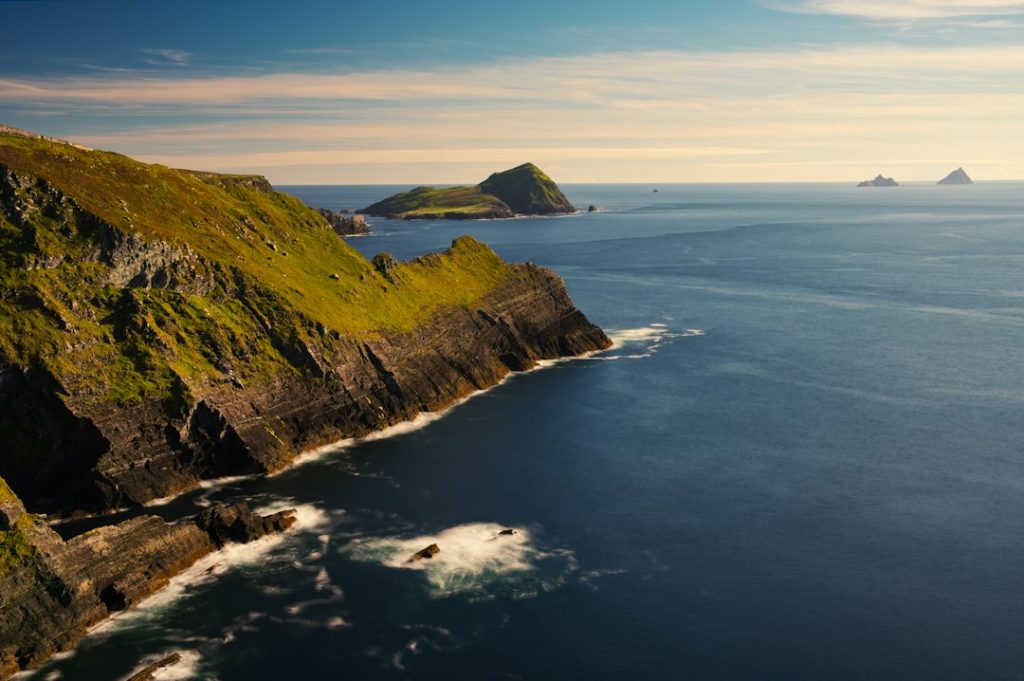
Twelve kilometers off the coast of County Kerry, two sharp pyramids of ancient rock pierce the Atlantic sky. The Skellig Islands—Skellig Michael and Little Skellig—rise 218 meters above churning waves, their silhouettes so dramatic they’ve been called Ireland’s most improbable landscape. One is home to 30,000 gannets. The other holds a 1,400-year-old monastery that clings to the stone like a prayer.
This is Ireland at its wildest, most mystical, and most unforgettable. And if you’re willing to brave the boat ride and the climb, a day on the Skelligs will change how you see the edge of the world.
The Boat Ride Out: Where the Journey Begins
The only way to reach Skellig Michael is by boat from Portmagee or Ballinskelligs, and the crossing itself is part of the pilgrimage. Licensed operators run trips from May through September, weather permitting—and the Atlantic gets final say. Expect a 45-minute to one-hour ride over open ocean, with swells that can lift and drop the boat in ways that test your sea legs.
But as the mainland shrinks behind you, the Skelligs grow larger and stranger. Little Skellig appears first, its white surface shimmering—not with snow, but with tens of thousands of nesting gannets. The noise, the smell, the sheer density of life on that rock is staggering. You won’t land there; it’s a protected sanctuary. But you’ll circle close enough to see the birds wheeling and diving, their calls echoing off the cliffs.
Then Skellig Michael rises ahead, steep and impossibly green in places, its stone staircases visible even from the water. This is where you’re going.
The Climb: 600 Steps Into the Past
Once ashore, the real journey begins. There are roughly 600 stone steps between the island’s landing and the monastery at the summit, carved by monks more than a millennium ago. The steps are uneven, steep in places, and built without railings. You climb single-file, pausing to catch your breath and take in views that seem to belong to another age.
Puffins nest in the crevices during early summer. Fulmars glide past at eye level. The ocean stretches in every direction, unbroken except for the shadow of Little Skellig and the faint line of the Kerry coast.
At the top, you reach the monastery—six beehive huts (clochans), two oratories, and a cluster of stone crosses and graves, all constructed without mortar. Monks lived here from the 6th century until the 12th, in one of the most isolated Christian settlements ever built. They grew no crops. They survived on fish, seabirds, and rainwater. They prayed, copied manuscripts, and endured Atlantic storms that must have felt apocalyptic.
Standing among the huts, with wind whipping around the summit and nothing but sky and sea beyond, you understand why they came. This place strips everything else away.
What to Know Before You Go
Trips to Skellig Michael are limited by the Irish government to protect the site, and only a handful of boats are licensed to land there. Book well in advance—months, if you’re planning a summer visit. Expect to pay around $100–$130 per person for the boat trip.
Wear sturdy shoes with good grip; the steps can be slick. Bring layers, even in summer—it’s always cooler and windier on the island. Seasickness tablets are a wise precaution, and there are no facilities on Skellig Michael, so plan accordingly.
The island is open to visitors roughly from late May through September, but the season depends entirely on the Atlantic. Cancellations due to weather or rough seas are common. If your trip is called off, most operators will try to reschedule, but there are no guarantees. Build flexibility into your itinerary if you can.
Why the Skelligs Matter
Skellig Michael is a UNESCO World Heritage Site, and for good reason. It represents one of the most extreme examples of early Christian monasticism, a place where faith and endurance met the raw edge of the natural world. The stonework alone—dry-built structures that have withstood 1,400 winters—is a marvel of engineering and determination.
But beyond the history, the Skelligs offer something harder to quantify: a sense of awe that’s increasingly rare. In an age of constant noise and distraction, spending a day on a windswept rock in the Atlantic, surrounded by seabirds and ancient stone, is a kind of reset. You return to the mainland quieter, smaller, and somehow more awake.
If you love Ireland for its wild beauty, its layered history, and its ability to surprise you with places that feel untouched by time, the Skellig Islands belong on your list. Just be ready for the ocean, the climb, and the silence at the top.
Want more stories from the edges and heart of Ireland? Subscribe to the Ireland Moments newsletter—a daily celebration of the places, traditions, and moments that make the Emerald Isle unforgettable.