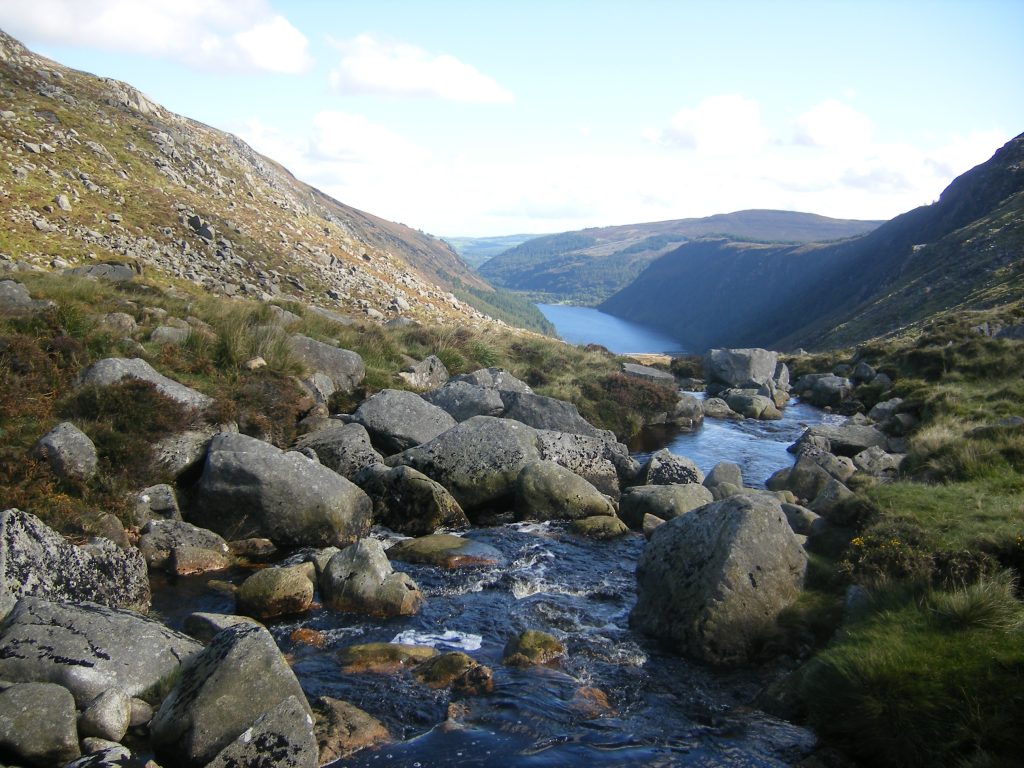
The name says it all: Glendalough, from the Irish Gleann Dá Loch, means “Valley of the Two Lakes.” But this glacial valley in County Wicklow is far more than a beautiful place to walk. It’s one of Ireland’s most important early Christian sites, a landscape where nature and history have been woven together for more than 1,500 years.
Founded in the 6th century by St. Kevin, a hermit seeking solitude in the wild Wicklow Mountains, Glendalough became a thriving monastic city and a center of learning that drew pilgrims from across Europe. Today, its stone ruins, round tower, and forest trails attract visitors who come for the history, the hiking, and the rare sense of peace that still lingers here.
The Monastic City
Walking into the main monastic site feels like stepping into a medieval manuscript. The ruins are compact but remarkably preserved: stone churches with doorways barely wide enough for one person, a nearly perfect round tower rising 100 feet into the sky, and a graveyard filled with Celtic crosses worn smooth by centuries of wind and rain.
The round tower is Glendalough’s most iconic feature. Built around the 10th century, it served as a bell tower, a lookout, and a place of refuge during Viking raids. The doorway sits ten feet above the ground—originally accessible only by ladder. Stand beneath it and imagine monks scrambling to safety with manuscripts and relics as longships appeared in the valley below.
The Cathedral, the largest of the seven churches on the site, still has its walls standing and a beautiful chancel arch intact. Nearby, the tiny Priest’s House was likely a mortuary chapel, with intricate stone carvings still visible above the door. And St. Kevin’s Church, known locally as St. Kevin’s Kitchen because of its stone roof and chimney-like bell tower, is one of the best-preserved early Irish churches you’ll find anywhere.
The Upper Lake and St. Kevin’s Bed
Most visitors explore the main monastic site, but the walk to the Upper Lake—about a mile west along a forested trail—is where Glendalough reveals its quieter, wilder side. The path follows the Glenealo River through oak and birch woodland, and the light filtering through the canopy feels cathedral-like in its own right.
The Upper Lake sits in a glacial bowl, surrounded by steep cliffs and thick forest. It’s where St. Kevin is said to have lived as a hermit in a cave carved into the rock face above the water. The cave, known as St. Kevin’s Bed, is visible from the shore but unreachable without climbing gear. Legend says Kevin lived there for seven years, subsisting on nettles and salmon brought by an otter, and that a blackbird once laid an egg in his outstretched hand during prayer—and he held the pose until the chick hatched.
The site of Reefert Church, a small ruin near the Upper Lake, marks the burial place of local chieftains. It’s peaceful, overgrown, and rarely crowded—a reminder that Glendalough was as much a place of power as it was of prayer.
Hiking the Wicklow Way
Glendalough sits along the Wicklow Way, Ireland’s oldest long-distance walking trail, which runs 81 miles from Dublin to Clonegal in County Carlow. Even if you’re not tackling the full route, there are several marked trails that start from the valley, ranging from easy lakeside loops to challenging climbs into the surrounding mountains.
The Spink Trail is a favorite: a steep, rocky scramble that rewards you with sweeping views over both lakes and the valley below. It’s about 7 miles round-trip and takes three to four hours, depending on how long you linger at the viewpoints. Bring good boots—the terrain is rugged, and the weather in Wicklow can change fast.
For a gentler walk, the Green Road loop follows old miners’ tracks through the valley and offers closer views of the monastic ruins and surrounding forest. It’s about 5 miles and relatively flat, suitable for families or anyone looking for a peaceful afternoon in the hills.
Visiting Glendalough
Glendalough is about 30 miles south of Dublin, an easy day trip by car or bus. Entry to the monastic site is free, and the Glendalough Visitor Centre (around $6 per adult) offers a short film and exhibits that help bring the history to life. The site is open year-round, but it’s quietest early in the morning or late in the afternoon, especially outside the summer months.
There’s a small café near the Lower Lake serving hot drinks and light meals, and the village of Laragh, just a mile away, has pubs and guesthouses if you want to stay longer. The Wicklow Mountains are best explored slowly, and Glendalough rewards those who take their time.
This is a place where Ireland’s layers—spiritual, natural, historical—sit side by side without shouting. The stones don’t need much explanation. The valley speaks for itself.
Love stories like this? Subscribe to the Ireland Moments newsletter and get a daily celebration of Ireland’s places, music, history, and culture delivered to your inbox.