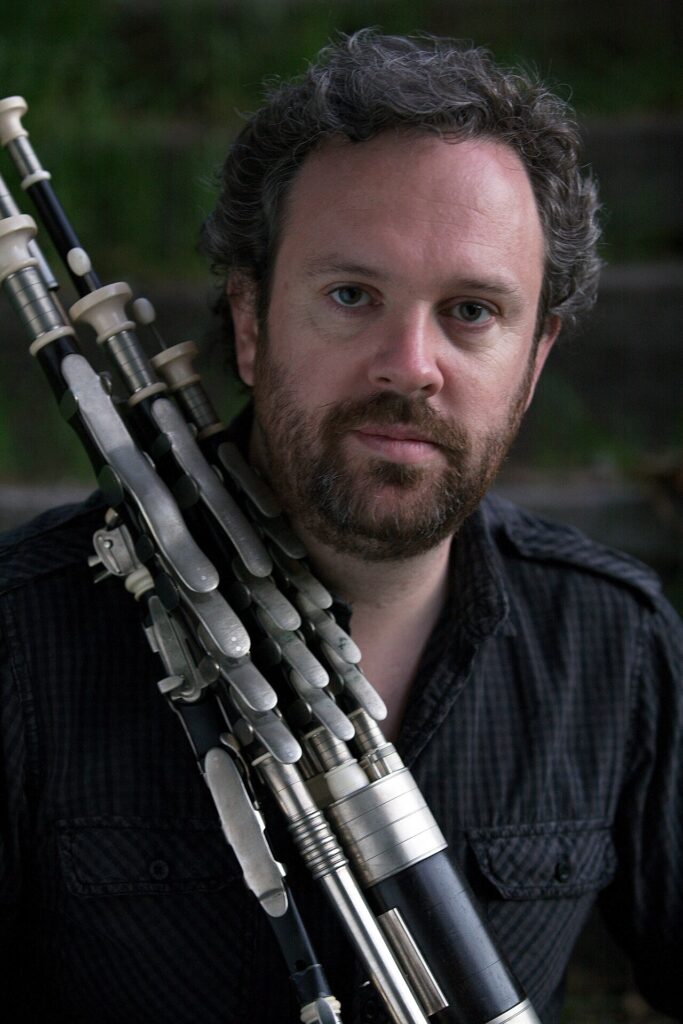
Walk into any serious trad session in Dublin, Clare, or Sligo, and you’ll hear fiddles, flutes, and bodhráns filling the room. But when the uilleann pipes enter, everything shifts. The sound is unmistakable—rich, reedy, and layered with a complexity no other Irish instrument can match. These aren’t the wailing war pipes of Scotland; the uilleann pipes are quieter, more intricate, and utterly Irish.
Played seated with a bellows tucked under the elbow—uilleann means “elbow” in Irish—these pipes can play two octaves chromatically, accompany themselves with drones and regulators, and shift from a slow air that breaks your heart to a reel that sets your feet moving. They’re the most technically demanding instrument in Irish traditional music, and the most rewarding to hear in skilled hands.
An Instrument Built for Expression
The uilleann pipes evolved in Ireland during the 18th century, developing from earlier bagpipe traditions into something uniquely suited to the nuance of Irish music. Unlike Highland pipes, which are loud and built for outdoor use, uilleann pipes are indoor instruments—perfect for the intimate settings of kitchens, parlors, and pubs.
The chanter plays the melody, while three drones provide a constant harmonic foundation. But the real magic lies in the regulators—keyed pipes that rest on the piper’s thigh and can be struck to add chords and rhythmic punctuation. A skilled piper like Liam O’Flynn, Paddy Keenan, or Davy Spillane uses all these elements together, creating a sound that’s almost orchestral.
The pipes are also incredibly expressive. By controlling the pressure of the bellows and using a technique called “tight fingering,” pipers can create subtle dynamics, ornamentation, and even silence—something impossible on many other bagpipes. That’s why uilleann pipers can play slow airs with the same emotional depth as a sean-nós singer.
Where to Hear Them
If you want to hear uilleann pipes played at their best, you need to seek out the sessions and concerts where master pipers gather. Na Píobairí Uilleann, the pipers’ organization based in Dublin, hosts regular events and maintains a archive of recordings and manuscripts at Henrietta Street. Their annual Tionól festival brings pipers from across Ireland and the world to share tunes, techniques, and stories.
In County Clare, you’ll often find pipers at sessions in Ennis, Miltown Malbay, and Doolin—especially during the Willie Clancy Summer School in July, a week-long gathering named after one of the greatest pipers who ever lived. Willie Clancy’s playing is still the gold standard, and his recordings remain essential listening for anyone who wants to understand what these pipes can do.
For a more formal setting, catch a concert by The Chieftains, whose founding member Paddy Moloney brought the uilleann pipes to global audiences, or see younger players like Mick O’Brien, Michael McGoldrick, or David Power, who are carrying the tradition forward with both reverence and innovation.
Learning the Craft
Taking up the uilleann pipes is not for the faint of heart. A full set of pipes can cost anywhere from $3,000 to $15,000 or more, and most learners start with a practice set—just the chanter and a bellows—to master fingering and breath control before adding drones and regulators.
It takes years to develop the coordination, stamina, and musical knowledge required to play well. But those who stick with it join a tradition that stretches back centuries and connects them to some of the most iconic music Ireland has ever produced.
Organizations like Na Píobairí Uilleann and Comhaltas Ceoltóirí Éireann offer classes and resources for learners, and many pipers are generous with their time, passing along tunes and techniques just as they were taught.
Why They Matter
The uilleann pipes represent something essential about Irish music—its ability to be both deeply personal and communal, both ancient and alive. They require patience, dedication, and a respect for the tradition, but they reward the listener with a sound that can’t be replicated by any other instrument.
Whether it’s a slow air like “An Chúilfhionn” that stops a room cold, or a spirited reel that drives a session forward, the uilleann pipes capture the full emotional range of Ireland. They’re a living link to the past and a vital voice in the present, reminding us why Irish music continues to move people across the world.
Want more stories celebrating the music, culture, and spirit of Ireland? Subscribe to the Ireland Moments newsletter—a daily celebration of the Emerald Isle, delivered straight to your inbox.