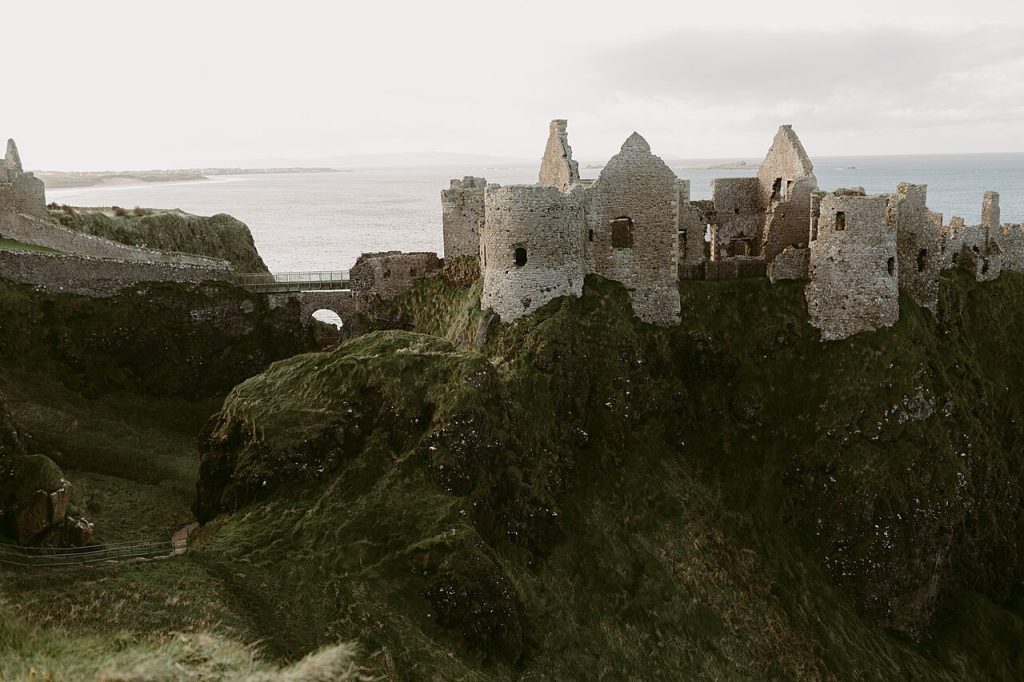
There are castles that sit comfortably in valleys, and then there’s Dunluce Castle—a medieval fortress clinging to a basalt outcrop on the Causeway Coast of County Antrim, with nothing between its crumbling walls and a sheer drop to the sea but centuries of storms and stories.
Even in ruins, Dunluce commands attention. The Atlantic wind whips through its empty windows. Waves explode against the rocks a hundred feet below. And visitors stand at the edge, trying to imagine what kind of people chose to build—and live—in a place this wild.
A Castle Built on Drama
Dunluce was constructed in the 13th century by the MacQuillan family, but it’s the MacDonnells—Lords of the Isles—who left their mark here in the 1500s. Sorley Boy MacDonnell fortified the castle with cannons salvaged from the Spanish Armada ship Girona, wrecked nearby in 1588. Those cannons still point seaward from the gatehouse, a reminder that this wasn’t just a home—it was a stronghold.
The castle’s layout sprawls across the headland: a gatehouse, courtyard, great hall, and living quarters that once housed one of Ulster’s most powerful Gaelic families. But nature had other plans. In 1639, part of the kitchen collapsed into the sea during a storm, taking several servants with it. The MacDonnells abandoned Dunluce soon after, and it’s been a ruin ever since.
What You’ll See Today
Dunluce is managed by the Department for Communities Northern Ireland, and it’s open year-round. The entrance fee is around $7 for adults, with discounts for children and seniors. A modern visitor center offers context before you walk the short path to the castle itself.
Once through the gatehouse, you’re free to explore the ruins at your own pace. The great hall still has enough structure to give a sense of scale—high walls, deep fireplaces, and windows that frame the ocean like living paintings. Below the castle, accessible by a stone stairway cut into the cliff, is the Mermaid’s Cave, a natural sea cave that legend says was home to a mermaid who fell in love with a MacDonnell lord.
The views alone justify the visit. To the east, you can see the Giant’s Causeway, just two miles down the coast. To the west, the cliffs stretch toward Portrush and beyond. On clear days, the outline of Scotland’s Mull of Kintyre appears on the horizon—a reminder of the MacDonnells’ Scots-Irish heritage.
Ghosts, Legends, and a Kitchen That Fell Into the Sea
Dunluce doesn’t need embellishment to feel haunted. The collapse of the kitchen is historical fact, but over time it’s become part of local folklore. Some say the ghost of a servant girl still wanders the ruins. Others claim you can hear the echo of dishes crashing into the waves on stormy nights.
Then there’s the story of Maeve Roe, daughter of a MacDonnell lord, who was locked in the castle’s tower after refusing an arranged marriage. She tried to escape by climbing down the cliffs with her lover, but both fell to their deaths. Locals say her spirit still haunts the ruins, especially near the tower that bears her name.
Whether or not you believe in ghosts, there’s no denying the atmosphere. Dunluce feels lived-in and lost at the same time—a place where history hasn’t been sanitized, just left to weather and memory.
How to Visit
Dunluce Castle is located on the Causeway Coastal Route, one of the most scenic drives in Ireland. It’s about 5 miles east of Portrush and 2 miles west of the Giant’s Causeway, making it an easy stop on a day exploring the North Coast.
The castle is open daily, though hours vary by season. Summer months (June through August) offer the longest visiting times, typically 10 a.m. to 5 p.m. Winter hours are shorter. Check ahead if you’re visiting outside peak season.
Wear sturdy shoes—the ground is uneven, and the clifftop can be slippery when wet. Bring a windbreaker, even in summer. The Atlantic doesn’t take days off, and neither does the wind.
If you’re combining Dunluce with the Giant’s Causeway, plan for a full day. Add in a stop at the Carrick-a-Rede Rope Bridge or the Dark Hedges, and you’ve got one of the best road trips Ireland offers.
Why It Still Matters
Dunluce isn’t the grandest castle in Ireland, nor the best preserved. But it might be the most dramatic. It’s a place that refuses to be tamed—by weather, by time, or by tourist expectations. Standing in the courtyard with the wind howling and the sea crashing below, you understand why the MacDonnells built here, and why they eventually had to leave.
It’s a castle that earned its legends honestly, one storm at a time.
If Dunluce and the wild beauty of Ireland’s northern coast speak to you, subscribe to the Ireland Moments newsletter—a daily celebration of the places, stories, and traditions that make the Emerald Isle unforgettable.