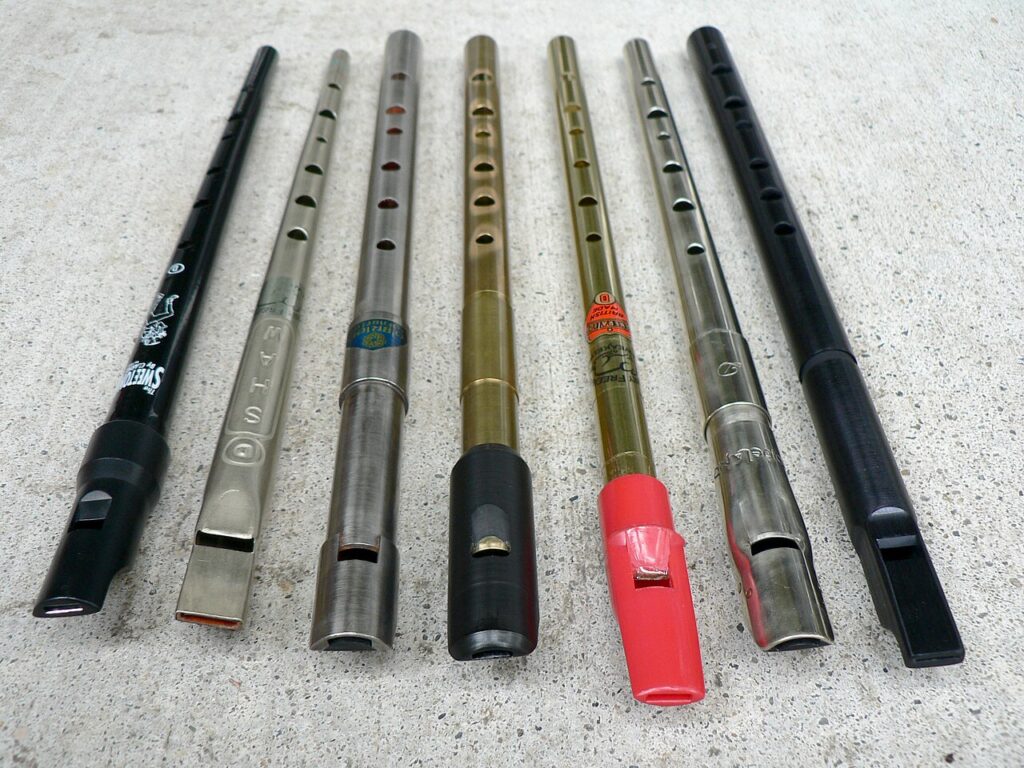
Walk into any trad session in Ireland and you’ll hear it: that clear, bright voice cutting through the fiddles and guitars, dancing above the bodhrán, carrying melodies that have traveled through centuries. The tin whistle — also called the penny whistle or feadóg stáin in Irish — is the instrument that launched a thousand musical journeys.
It’s the instrument children learn first in school, the one tucked into musicians’ jacket pockets on their way to the pub, and the voice behind some of the most recognizable Irish tunes ever recorded. Deceptively simple, endlessly expressive, and utterly Irish.
Six Holes, Endless Possibilities
The tin whistle consists of a metal tube, a plastic or wooden mouthpiece, and six finger holes. That’s it. No keys, no valves, no complicated mechanisms. You blow into one end, cover and uncover the holes, and out comes music. A child can play a simple tune within an hour. A master can make it weep, laugh, and soar.
Most players start with a whistle in the key of D, the standard for Irish traditional music. Clarke’s Original Tin Whistle, made in Suffolk but beloved across Ireland since the 1840s, remains the classic beginner’s choice at around $8. Generation’s whistle, handmrafted in County Clare, offers a warmer, richer tone favored by session players and runs about $25. Serious musicians often graduate to a Tony Dixon or Chieftain’s whistle.
The beauty lies in the simplicity. Unlike piano or guitar, there’s no forest of notes to memorize before you can play a tune. The whistle rewards you quickly, then spends a lifetime revealing its subtleties.
From Schoolrooms to Sessions
Nearly every Irish child learns the tin whistle in primary school. It’s Ireland’s musical rite of passage — the gateway to reading music, understanding rhythm, and most importantly, to the living tradition of Irish music. Those squeaky renditions of “Hot Cross Buns” in third class often blossom into a lifetime of sessions, céilís, and tune swapping.
But the whistle never stays in the classroom for long. Step into The Cobblestone in Dublin, Crane Bar in Galway, or Teach Beag in Spiddal, and you’ll find whistle players of all ages holding their own alongside seasoned fiddlers and pipers. The whistle commands respect in traditional circles — when Mary Bergin or Joanie Madden picks one up, everyone listens.
Its portability makes it the perfect session instrument. No case required, no tuning, no fuss. Just pull it from your pocket and join in. That accessibility has kept the whistle at the heart of Irish music for nearly two centuries.
The Sound of Ireland Itself
The tin whistle’s voice is unmistakably Irish. It’s the sound of “The Wind That Shakes the Barley,” the opening notes of “The Chieftains,” the melody threading through countless film soundtracks when directors want to evoke the Emerald Isle. That sweet, slightly breathy tone — neither harsh nor timid — carries the character of the music perfectly.
Technique matters more than you’d think. Ornamentation — the cuts, rolls, slides, and grace notes that give Irish music its distinctive lilt — separates a tune player from a whistle master. A simple jig like “The Irish Washerwoman” becomes something transcendent in skilled hands, each note breathing and dancing.
The whistle handles the full repertoire: jigs, reels, hornpipes, slow airs, and slip jigs. It can lead a session or weave harmonies beneath other instruments. In the right hands, it becomes intensely expressive, capable of remarkable emotion for such a simple piece of metal.
Start Your Own Journey
Want to join the tradition? Pick up a Clarke’s whistle in the key of D. Find a basic tutorial online or grab a copy of “The Complete Irish Tin Whistle Tutor” by L. E. McCullough. Learn “Twinkle, Twinkle, Little Star” to get your breath control right, then tackle “Danny Boy” or “Molly Malone.”
Within a week, you’ll be playing recognizable tunes. Within a month, you might brave your first slow session. Within a year, you’ll understand why this humble instrument has launched so many musical lives.
The tin whistle doesn’t just teach you to play Irish music — it opens a door into Irish culture itself, into sessions and friendships, into a living tradition that welcomes everyone who shows up with respect and willingness to learn.
Let Ireland’s stories arrive in your inbox each morning. Subscribe to the Ireland Moments newsletter for a daily celebration of the Emerald Isle — its music, landscapes, traditions, and the moments that make it unforgettable.